Territorial Gold · Private Coinage · Carolina Gold Rush · Original Numismatic Research · By Russell Augustin
The Mark of the Maker
How Two Deliberate Uses of a Single Punctuation Mark Encoded Identity and Verification into the Dies of America's Most Trusted Private Gold Mint
Rutherford County, North Carolina · 1831–1850
The Bechtler Family Mint · A New Framework for the Complete Kagin Series
A Colon That Changed Everything
For nearly two centuries, a small punctuation mark has sat quietly on some of the most historically significant gold coins ever struck in the United States.
The Bechtler family of Rutherford County, North Carolina — Christopher Bechtler Sr., his son Augustus, and his first cousin Carl Christopher Bechtler, who went by Christopher Jr. — operated a private gold mint from 1831 to approximately 1850. The two families had been partners in a jewelry shop in Germany before emigrating together, arriving in Philadelphia in 1829 and settling in Rutherford County in April 1830. Sr. also had a son named Charles, who died around 1841 and appears to have played no role in the coining operations. In the years the mint was active, the family struck more than $2.25 million in gold coins, denominated at $1, $2.50, and $5, in a workshop that rivaled the United States Mint in accuracy and surpassed it in the trust of the miners it served. Their coins circulated more freely than many federal issues, were accepted by banks, and were used as hard money well into the Civil War — decades after the mint closed.
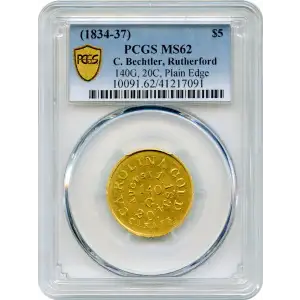
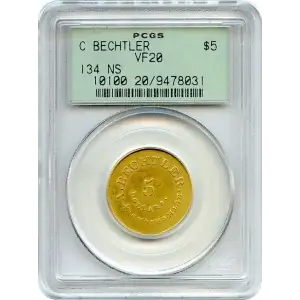
On some dies the legend reads C:BECHTLER — with a colon after the initial — while on others it reads C. BECHTLER. with a standard period. The catalogues call this a die variety. New research suggests it is something else entirely: a deliberate, ingenious system by which craftsmen sharing the same initials quietly marked their individual work product for accountability.
When the complete Kagin series is examined in its entirety — all 31 varieties from K-1 through K-31 — a more complex and more revealing pattern emerges. The colon appears in two structurally distinct positions across the series, each serving a separate and identifiable function. Together they constitute something no other private mint in American history ever attempted: a professional chain of custody encoded directly into the legend of the coin itself.
No Room for "Sr." on a $5 Gold Coin
The physical constraints of die-cutting drove an elegant solution.
A Bechtler $5 half eagle measures roughly 24 to 25 millimeters across. Its obverse die must accommodate the maker's name and mint location, while the reverse carries the precise weight and carat marks that were the family's commercial guarantee — all hand-punched, one character at a time, into steel dies the size of a thimble. There was simply no room for a "Sr." or any other qualifying inscription. Carl Christopher Bechtler — known within the family as Christopher Jr. — was moreover a first cousin, not a son, making "Jr." technically inapplicable even in daily usage, though the family did employ the Sr./Jr. convention informally to distinguish the two Christophers in conversation. Furthermore, Roman numerals "I" and "II" would have added characters to an already crowded die face.
The solution — elegant, practical, and entirely consistent with the German goldsmith tradition in which the family trained — was to vary a mark already present on the die. The period became the signature of the senior craftsman. The colon became the mark of the younger. And as the analysis below demonstrates, the colon's function expanded beyond identity to encompass an additional layer of professional attestation: personal verification of the weight figure itself.
Jefferson, Silversmiths, and the Language of Punctuation
The idea that punctuation could encode personal identity is not speculative — it has a long documented history.
The idea that a colon could serve as a personal ownership mark is not speculative. Thomas Jefferson habitually signed documents and ownership marks as "Th:J." — with a colon. When 18th-century Bordeaux bottles engraved "Th.J." with periods surfaced in the 1980s, experts flagged them immediately as forgeries. The punctuation was wrong. Jefferson used a colon. It carried meaning.
American silversmith dynasties of Boston and Connecticut had long used the same technique during the 18th and 19th centuries. The Merriman family of New Haven used "capitals, colons between, in serrated rectangle" as a deliberate generational house mark. The Burt family of Boston used "initial and surname, colon between" as John Burt's personal mark while his sons used different devices. The Cowell and Moulton families followed the same pattern across five and six generations — subtle punctuation variations on tiny metal surfaces serving precisely the accountability function the catalogues have failed to credit to the Bechtlers.
German hallmarks never used colons directly — they used clean initials in shields — but the principle of personal maker's-mark accountability was drilled into every Pforzheim apprentice. In America, with no guild enforcement and minuscule die faces, the Bechtlers adapted the tradition creatively and with considerably more sophistication than any prior analysis has recognized.
Two Households, One Workshop
Family records clarify a genealogy the coin catalogues have left imprecise for nearly two centuries.
The two men who shared the initial "C" on Bechtler dies were not father and son, nor uncle and nephew in the conventional sense. They were the sons of brothers. Lenz Bechtler and Alt Christopher Bechtler — born 1782 — were partners in a jewelry shop in Germany before the emigration. Lenz's son was Carl Christopher Bechtler, who took the name Christopher and is known to collectors as Christopher Sr. Alt's son was also named Christopher — Carl Christopher — who emigrated with the group, took the name Christopher Jr., and married Sophia Fleck Bechtler. The two households settled separately in Rutherford County but operated the mint as a shared enterprise.
Sr.'s household included his sons Augustus and Charles. Charles died around 1841 and left no apparent trace on the coinage. Augustus, who died in 1843 or 1844, cut the dies attributed to him in the Kagin series and gave his name to the A.BECHTLER varieties — K-24, K-25, K-27, K-28, and K-29 — before his early death closed that chapter of the workshop's production.
Christopher Jr.'s household grew quickly after the family's arrival: seven children were born between 1831 and 1848, the first — Edward — born in North Carolina in 1831, the very year the mint struck its first coins. One child, Louisa Augustus, was born in 1833 in Georgia. Family correspondence suggests the family was in Georgia that year to purchase gold directly from the source, or possibly to investigate the feasibility of a branch minting operation closer to the Georgia fields. Whether a Georgia branch was ever seriously planned remains unknown, but the family's direct commercial contact with Georgia gold suppliers is consistent with the specific provenance claims — GEORGIA GOLD — that appear on multiple Bechtler die varieties and that the workshop clearly considered worth marking explicitly.
Identity and Verification — Two Distinct Uses of a Single Mark
The colon does not serve one purpose in the Bechtler series — it serves two, each structurally distinct and identifiable by position and context.
The colon or period immediately following the initial "C" identifies which Christopher cut the obverse die. C. is Sr.'s mark. C: is Christopher Jr.'s. This is the signature function — the equivalent of "Sr." or "Jr." compressed into a single punch mark on a surface too small for either.
A colon after the grain weight abbreviation "G" signals that the craftsman who cut that die face personally verified the weight figure. In European commercial and technical writing of the period, a colon after an abbreviated unit of measure served as a shorthand attestation — "confirmed by the undersigned." G: is a signed weight. G. is a stated one. Given that the Bechtlers' entire commercial reputation rested on the accuracy of their weight claims — and that Templeton Reid's mint had recently collapsed specifically because his weight claims proved false — the distinction between a verified and a stated weight was not trivial. It was existential.
With this framework in place, every colon in the Kagin series becomes readable rather than anomalous. A coin bearing C:BECHTLER on the obverse and 128.G: on the reverse is a coin on which Christopher Jr. identified himself as die-cutter and personally verified the weight. Two functions. One punctuation mark. A complete professional accountability signature.
Kagin-10 Through Kagin-13: The Controlled Quartet
The most powerful evidence for the two-craftsman theory rests not on a pair of coins, but on four.
K-10, K-11, K-12, and K-13 all share a single obverse die, all struck with plain edges, all bearing the inverted "V" for "A" uniformly across obverse and all four reverse dies. Every variable that could confound the analysis is held constant. What differs between the four coins is exclusively the treatment of the reverse die — and those differences map precisely onto the two-function colon framework.
The shared obverse die carries no "C" initial — it reads simply BECHTLER. RUTHERF: 250 — meaning that the attribution question for this group rests entirely on the reverse dies.
VarietyReverse LegendEdgeReading| K-10 | CAROLINA GOLD. 67.G. 21. CARATS. | plain | No weight verification colon — weight stated. Earliest in group. |
| K-11 | :GEORGIA GOLD. 64.G. uneven 22. CARATS. | plain | Colon present before GEORGIA; period after GOLD; 64.G. period — weight stated, not verified. Uneven "22" consistent with Christopher Jr.'s hand. |
| K-12 | GEORGIA GOLD. 64.G. even 22. CARATS. | plain | Period throughout — Sr.'s reverse. Level "22" — experienced hand. Direct contrast to K-11 on same obverse die. |
| K-13 | CAROLINA GOLD. 70.G: 20. .CARATS. | plain | 70.G: — Function II weight verification. Christopher Jr. personally signs the weight. Extra period before CARATS: possible die damage or double punch. |
K-10 carries no weight verification colon — the earliest in the group, before Christopher Jr.'s colon convention was fully developed on reverse dies. K-11 carries a colon before GEORGIA and a period after GOLD; the period after 64.G. indicates a stated rather than verified weight, and the uneven "22" is consistent with Christopher Jr.'s hand. K-12 carries periods throughout: no weight verification colon, a level "22" — Sr.'s reverse, cut with the precision of a craftsman who has driven numeral punches for decades. K-13 carries the Function II weight verification colon — 70.G: — Christopher Jr. personally signing off on the weight.
The quartet is a timeline of Christopher Jr.'s colon convention developing in real time across four reverse dies attached to a single production obverse. K-10 has no verification. K-12 shows Sr.'s contrasting all-period style on the same obverse die. K-13 introduces weight verification. The system did not arrive fully formed — this controlled group lets us watch it being built.
K-17B — When the Initial Disappeared Entirely
Of all 29 Kagin varieties, K-17B presents the single most striking anomaly for the two-craftsman theory.
It is the only Bechtler $5 piece from the "C. BECHTLER" era in which the initial "C" is entirely absent — and, notably, in which the star device present on every other $5 variety is also missing. The die reads simply BECHTLER.AT RUTHERFORD 5 DOLLARS. — no initial, no star, no colon, no period after a letter that is not there. The simultaneous absence of both the personal initial and the star device suggests this was not a simple omission but a deliberate stripping of the obverse to its most elemental form.
Several explanations present themselves, none of which can be definitively ruled out given that K-17B is a unique or near-unique variety. One reading — consistent with the two-craftsman theory — is that the initial was deliberately omitted at a moment when both Christophers were simultaneously active and the question of whose mark to apply created a practical impasse. Rather than misattribute the work, the workshop struck a coin that claimed no individual maker.
A second, equally plausible reading places K-17B in the experimental category. The initial may have been omitted deliberately on a trial striking made to evaluate the die layout before the attribution decision was made — a proof-of-design piece rather than an impasse coin. The very scarcity of K-17B — consistent with a trial quantity rather than a production run — supports this interpretation at least as strongly as the impasse reading. K-17B is presented here as significant evidence rather than conclusive proof, and readers are encouraged to weigh both explanations.
Trial Strikes and Experimental Dies
The rarity profile of the Kagin series reveals a workshop inventing its system in real time.
The rarity profile of the Kagin series is deeply uneven in ways that the standard variety-attribution framework does not fully explain. Several varieties exist in quantities so small — or in the case of K-7, with only a single traced example — that "variety" may be the wrong word. "Experimental striking" or "die trial" may be more accurate for a meaningful subset of these pieces.
The Bechtlers were inventing a private coinage system from scratch, using handmade dies on a hand-powered press in a rural workshop without professional mint infrastructure. The die marriage information now available allows us to distinguish more precisely between obverse die experiments and reverse die experiments — a refinement not previously possible.
One traced: PCGS XF-AU Details. Kagin's 2017 Dr. Christopher Allan Collection, Lot 1610. Stack's 1963 Walton Sale, Lot 2249; Chapman 1924 Nygren Sale; Chapman 1921 Jenks Sale.
Two traced: Stack's 1966 Bolt Sale, Lot 1181, catalogued as BU; Stack's 1963 Walton Sale, Lot 2259, catalogued as XF.
One traced, unique. PCGS XF45. Kagin's 2017 Dr. Christopher Allan Collection, Lot 1621. Discovered in 1983 by North Carolina numismatist Danny Freeman and sold privately to Kagin's.
Three traced, one impounded. PCGS AU53 and PCGS VF20. Bowers & Ruddy 1981 Macfarland Collection, Lot 2055, possibly one of the PCGS examples above. Smithsonian Institution, ex Lilly Collection acquired 1968, ex "Kelley."
In each case, the die marriage information clarifies precisely which element of the coin was experimental. The trial was never the obverse — obverses were production dies shared across multiple varieties. The trial was always the reverse, the edge, or both.
Shared Obverse Dies and What They Reveal
Die marriage information provides a structural map of the workshop's production sequence.
In the dollar series, K-1, K-2, and K-3 share a single obverse die. The shared obverse carries the period C.BECHTLER. legend throughout, confirming Sr.'s authorship of the obverse die across what appears to be a multi-year production run spanning the 1831–1837 period. Three successive reverse dies were paired with this one obverse as the grain weight standard was adjusted — 30.G. on K-1, 28.G. high on K-2, 28.G. centered on K-3. The obverse die's longevity is itself evidence of the workshop's economy with its tooling.
In the quarter eagle series, K-6, K-7, and K-8 share an obverse die, confirming that K-7's unusual reverse layout was a reverse die experiment on a standard production obverse. K-10, K-11, K-12, and K-13 share a second obverse die — the controlled quartet discussed at length above.
In the half eagle series, K-14 and K-15 share an obverse die, confirming that K-14's missing grain weight was a reverse die trial. K-17 shares a reverse die relationship with K-21 and K-22 — a connection that most likely reflects die reworking or template reuse rather than a literally identical working die and deserves physical examination to clarify. K-18, K-19, K-20, K-23, and K-26 share an obverse die carrying Christopher Jr.'s C:BECHTLER.AT RUTHERF: legend — confirming one long-lived Christopher Jr. obverse die served across multiple reverse treatments and both plain and reeded edge trials. K-27, K-28, and K-29 share Augustus's obverse die, with three successive reverse dies reflecting changing gold sources and weight standards across his production period.
The Panic of 1837 and Federal Competition
Hard money, wildcat banks, and why accountability was everything.
A booming mid-1830s economy had fueled rampant speculation in western lands, cotton, and slaves. Andrew Jackson vetoed the recharter of the Second Bank of the United States in 1836, ending central banking and unleashing hundreds of unregulated "wildcat" state banks issuing paper money with no hard reserve. His Specie Circular of 1836 then required payment for public land in gold or silver only, draining hard currency from eastern banks and bursting the land bubble. The Bank of England raised interest rates and pulled capital from American markets. Cotton prices — the lifeblood of Southern export — collapsed. Bank runs cascaded across the country beginning in May 1837.
In this environment the Bechtler punctuation system was not merely a family bookkeeping device. It was the operational infrastructure of a private monetary institution that had to be trusted absolutely in a landscape where nearly every other form of money had become suspect. Any coin that failed could be traced not just to the mint but to the specific craftsman who had signed his name to it in punctuation.
The Charlotte Branch Mint opened seventy miles east in March 1838. The Bechtlers kept operating for another twelve years — because their 2.5 percent fee often returned more pure gold to the miner than the federal alternative after transport costs and delays, and because the Bechtler system offered something the Charlotte Mint with its anonymous institutional production could not: personal accountability at the level of the individual die. Every colon was a craftsman's name on the work.
Coins That Outlived Their Mint by a Generation
The final years of the mint's operation almost certainly belonged to Christopher Jr. alone. Augustus died in 1843 or 1844, and Christopher Jr. continued to have children as late as 1848 — evidence of an active household and an ongoing presence in Rutherford County through the mint's closing years. The A.BECHTLER varieties end with Augustus's death; what came after, in whatever form the workshop continued, was Christopher Jr.'s enterprise. The colon convention he had been developing since 1834 was by then fully his own.
When the Bechtler mint closed around 1850, its coins did not retire with it. Confederate paper currency depreciated rapidly from 1861 onward. Hard money became the only reliable medium of exchange across much of the former Confederacy. Contracts and commercial accounts explicitly specified payment "in Bechtler gold." The coins had been out of production for more than a decade, yet their proven purity — and the transparent accountability system that had maintained it — kept them circulating at par or better with United States gold. The colons worked. They still work. They are working now, telling us exactly what they were always meant to say.
Research developed across two AI-assisted numismatic research sessions
Bechtler Colon Theory originated by Russell Augustin
Private Gold Coins and Patterns of the United States · Donald H. Kagin, PhD
Complete Kagin Series K-1 through K-31 Analyzed
© Original research, all rights reserved