- 630-280-7300
- Free shipping over $4,500

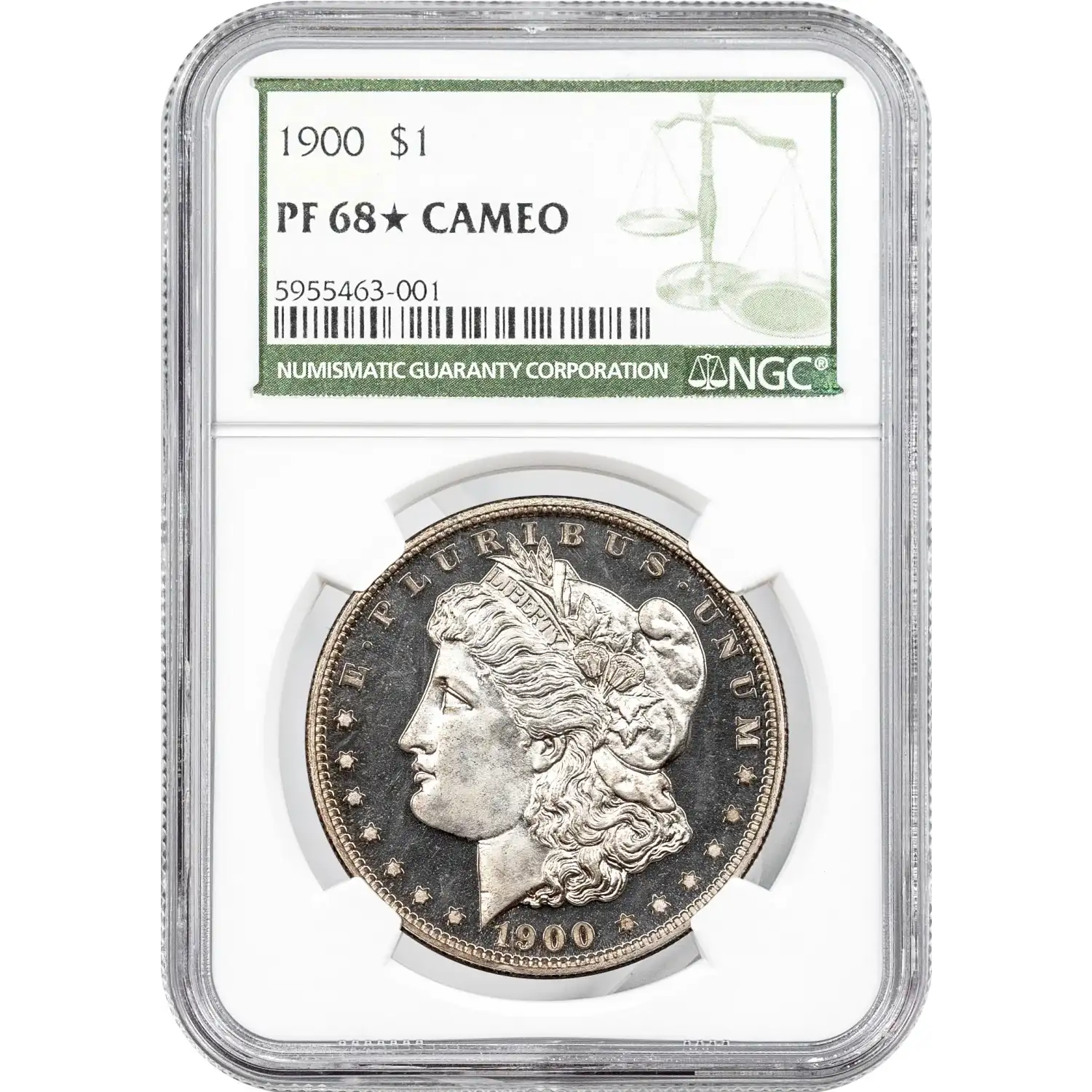
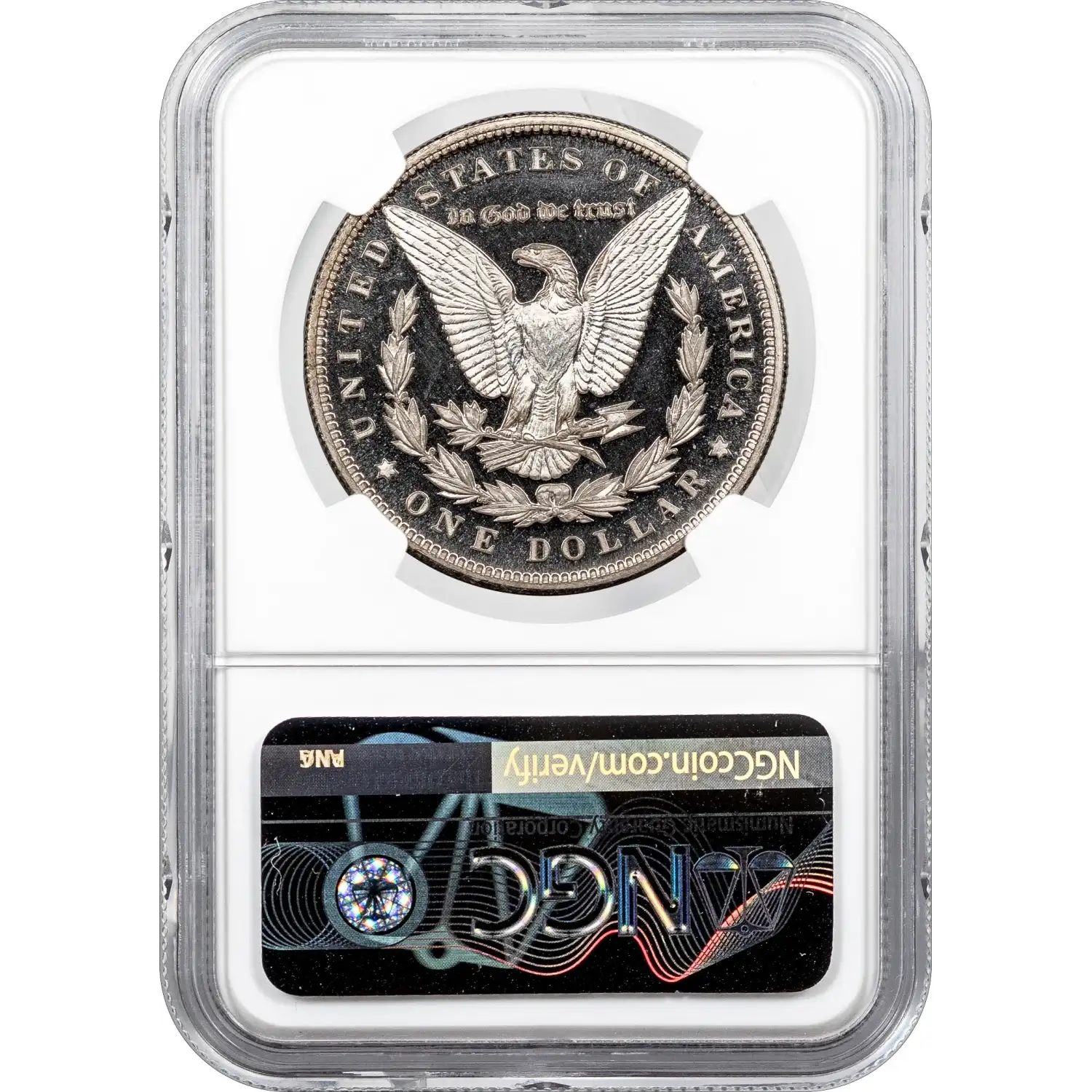
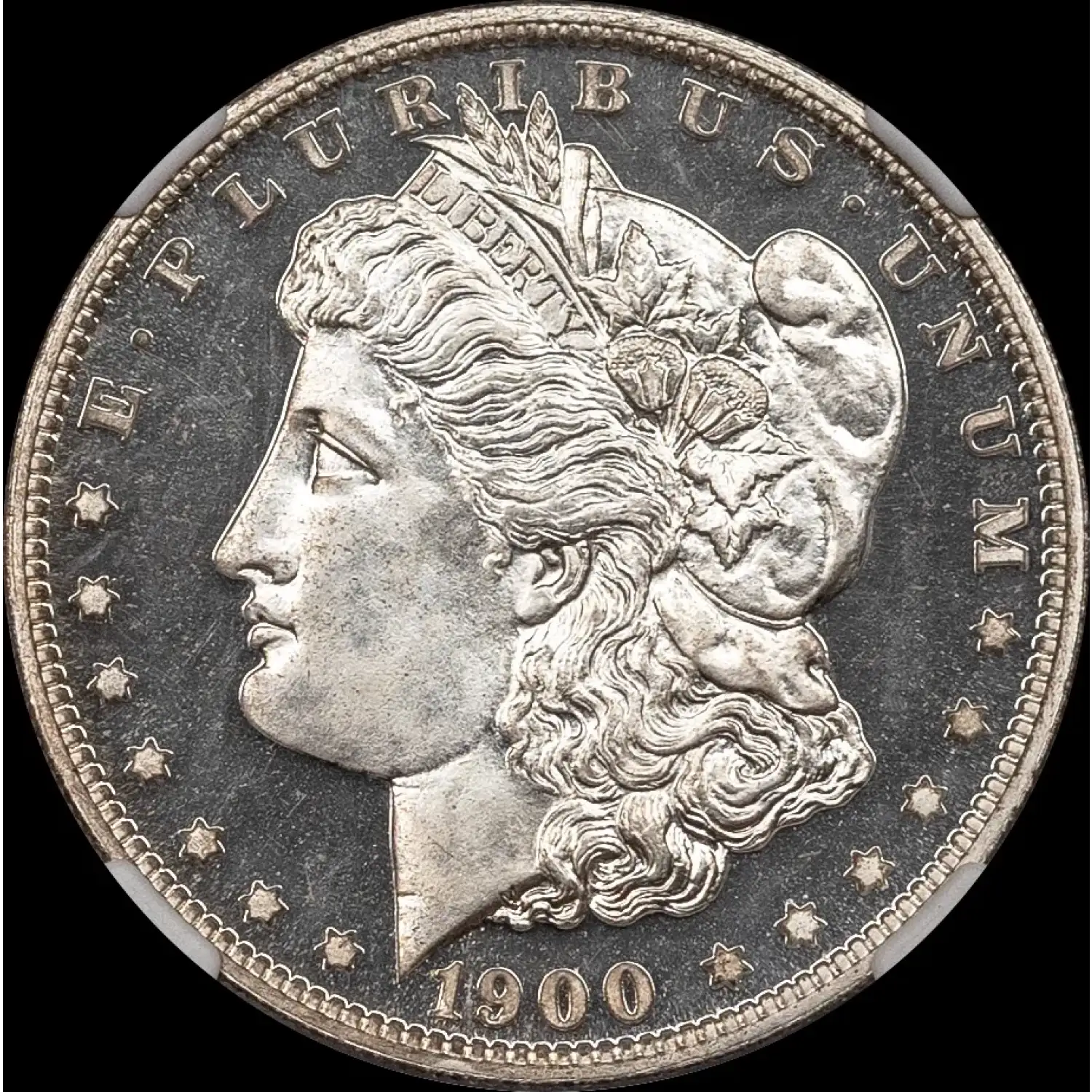
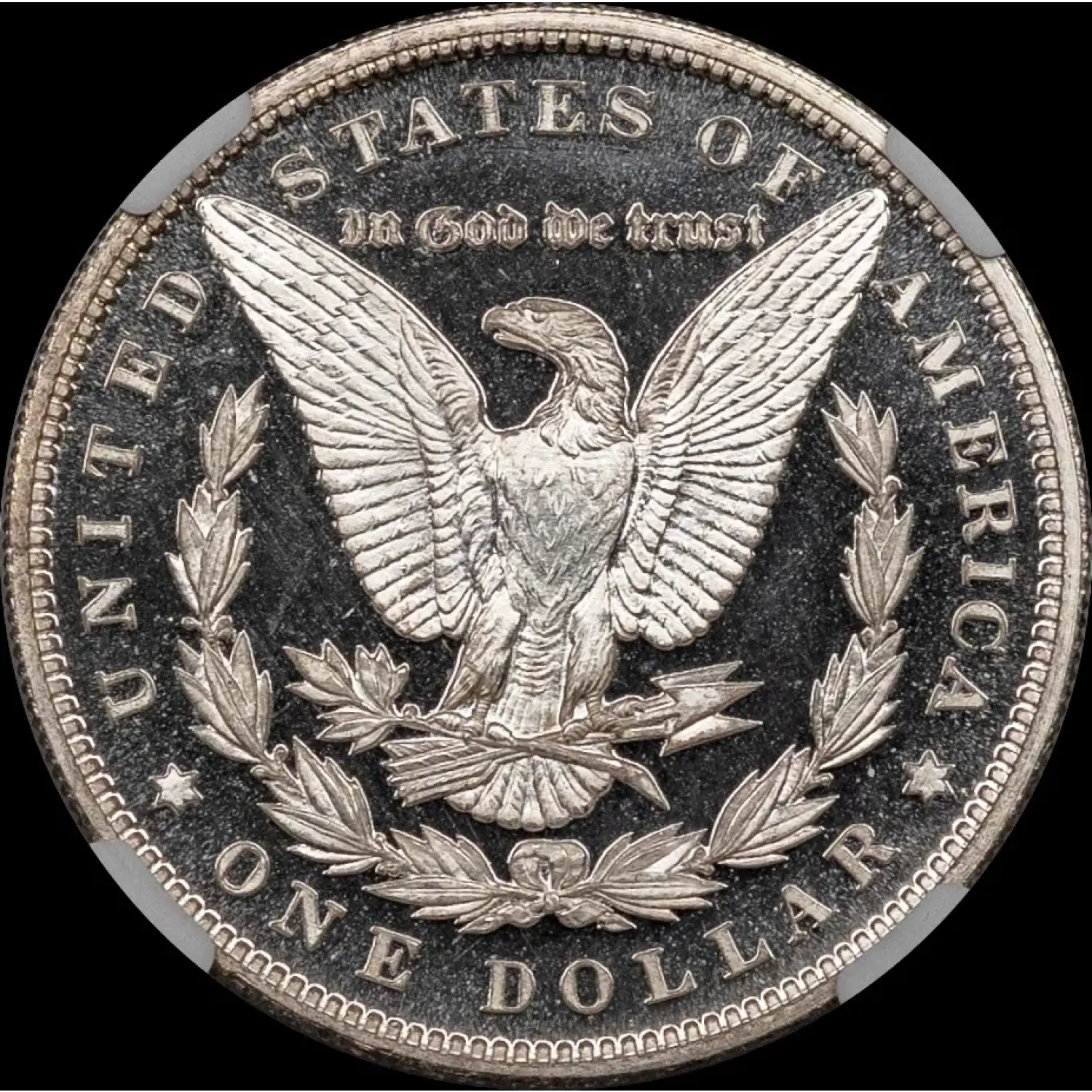
1900 Morgan Silver Dollar, Proof. Philadelphia Mint. George T. Morgan, designer. Silver, .900 fine; 26.73 g; 38.1 mm; reeded edge. Graded Proof-68 Cameo ★ by Numismatic Guaranty Company.
The Morgan dollar exists because of the Coinage Act of 1873. That statute struck the silver dollar from the roster of authorized coins and carried the nation onto a de facto gold standard; the Bland–Allison Act of February 28, 1878, passed over President Hayes's veto, was the silver interest's answer, and George T. Morgan's design was the object in which that answer was cast. The coin's subsequent history is a ledger of the same quarrel. The Sherman Silver Purchase Act of 1890 enlarged the Treasury's obligation to buy silver; the Panic of 1893 destroyed it, and the purchasing clause was repealed on November 1 of that year. Then, at the urging of congressmen from the mining states, a clause was inserted into an 1898 war-revenue bill compelling the Mint to coin the remaining Sherman Act bullion into standard dollars — a mandate that drove silver dollar production until the bullion was exhausted in 1904. The Philadelphia Mint's contribution for 1900 was 8,830,000 circulation strikes and 912 proofs. On March 14 of that same year, President McKinley signed the Gold Standard Act, making de jure what the Act of 1873 had made de facto twenty-seven years earlier. This coin, then, is a proof of the concession silver won, struck in the year silver's larger case was formally lost.
Of those 912 proofs — the largest proof delivery of the series' closing decade save the 972 pieces of 1894 — the great majority survive in the PR62 to PR64 range, and fewer than a fifth of all grades earn the Cameo designation. Deep Cameo examples number in the single digits at any grade. The reason is mechanical rather than deliberate: a freshly prepared proof die yielded thick frost on the devices and profound mirrors in the fields for only the first few dozen impressions, after which the frost polished away. Contrast was therefore a function of a coin's position in the striking sequence, and it disappeared entirely once the Mint's die preparation shifted after 1901 toward the uniformly brilliant, contrast-free surfaces that characterize the proofs of 1902 through 1904. The 1900 and 1901 issues are the last in which a Morgan proof could still look like the celebrated black-and-white pieces of the 1890s. At Proof-68, the present coin stands among roughly a dozen at the summit of the combined certified census. The Star is a further and more precise distinction. NGC has awarded it to well under one percent of eligible coins, and for an untoned proof already carrying the Cameo designation, the Star signifies specifically that the obverse attains Ultra Cameo contrast while the coin as a pair falls short of that standard. The asymmetry is not a defect; it is the record of an obverse die caught one impression earlier in its life than its mate.
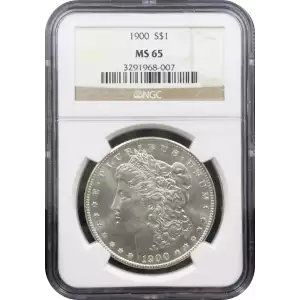
The coin is fully struck, its raised elements thickly and evenly frosted, the fields glassy and unbroken. Contrast is dramatic and white on black, shifting in intensity with the angle of light — the visual signature, precisely, of the obverse's superior frost. Liberty's hair and the cotton bolls above her ear are crisply defined and velvety in texture; the eagle's breast feathers show no compromise. There is no trace of handling, no hairline, no spot in the focal areas. A century and a quarter after it left the medal press, this is a coin that has never been anything other than what it was made to be: an object struck not to be spent but to be looked at, sold across a counter at Philadelphia to a collector who understood that the dollar in his hand was already a political relic. It has been looked at ever since, and never once spent.
We trace this coin previously from the The Lonestar Collection and The Greensboro Collection, both offered for sale within the past century.
1900 Morgan Silver Dollar, Proof
Philadelphia Mint. George T. Morgan, designer. Silver, .900 fine; 26.73 g; 38.1 mm; reeded edge. Graded Proof-68 Cameo ★ by Numismatic Guaranty Company.
The Morgan dollar exists because of the Coinage Act of 1873. That statute struck the silver dollar from the roster of authorized coins and carried the nation onto a de facto gold standard; the Bland–Allison Act of February 28, 1878, passed over President Hayes's veto, was the silver interest's answer, and George T. Morgan's design was the object in which that answer was cast. The coin's subsequent history is a ledger of the same quarrel. The Sherman Silver Purchase Act of 1890 enlarged the Treasury's obligation to buy silver; the Panic of 1893 destroyed it, and the purchasing clause was repealed on November 1 of that year. Then, at the urging of congressmen from the mining states, a clause was inserted into an 1898 war-revenue bill compelling the Mint to coin the remaining Sherman Act bullion into standard dollars — a mandate that drove silver dollar production until the bullion was exhausted in 1904. The Philadelphia Mint's contribution for 1900 was 8,830,000 circulation strikes and 912 proofs. On March 14 of that same year, President McKinley signed the Gold Standard Act, making de jure what the Act of 1873 had made de facto twenty-seven years earlier. This coin, then, is a proof of the concession silver won, struck in the year silver's larger case was formally lost.
Of those 912 proofs — the largest proof delivery of the series' closing decade save the 972 pieces of 1894 — the great majority survive in the PR62 to PR64 range, and fewer than a fifth of all grades earn the Cameo designation. Deep Cameo examples number in the single digits at any grade. The reason is mechanical rather than deliberate: a freshly prepared proof die yielded thick frost on the devices and profound mirrors in the fields for only the first few dozen impressions, after which the frost polished away. Contrast was therefore a function of a coin's position in the striking sequence, and it disappeared entirely once the Mint's die preparation shifted after 1901 toward the uniformly brilliant, contrast-free surfaces that characterize the proofs of 1902 through 1904. The 1900 and 1901 issues are the last in which a Morgan proof could still look like the celebrated black-and-white pieces of the 1890s. At Proof-68, the present coin stands among roughly a dozen at the summit of the combined certified census. The Star is a further and more precise distinction. NGC has awarded it to well under one percent of eligible coins, and for an untoned proof already carrying the Cameo designation, the Star signifies specifically that the obverse attains Ultra Cameo contrast while the coin as a pair falls short of that standard. The asymmetry is not a defect; it is the record of an obverse die caught one impression earlier in its life than its mate.
The coin is fully struck, its raised elements thickly and evenly frosted, the fields glassy and unbroken. Contrast is dramatic and white on black, shifting in intensity with the angle of light — the visual signature, precisely, of the obverse's superior frost. Liberty's hair and the cotton bolls above her ear are crisply defined and velvety in texture; the eagle's breast feathers show no compromise. There is no trace of handling, no hairline, no spot in the focal areas. A century and a quarter after it left the medal press, this is a coin that has never been anything other than what it was made to be: an object struck not to be spent but to be looked at, sold across a counter at Philadelphia to a collector who understood that the dollar in his hand was already a political relic. It has been looked at ever since, and never once spent.
250,000+ Reviews
‘’AU Capital Management, LLC is a leading supplier of rare coins, paper money and precious metals. Committed to authenticity, they strive to serve customers with high-quality goods they'll treasure..’’
 Verified Customer
‘’AU Capital Management, LLC is a leading supplier of rare coins, paper money and precious metals. Committed to authenticity, they strive to serve customers with high-quality goods they'll treasure..’’
Verified Customer
‘’AU Capital Management, LLC is a leading supplier of rare coins, paper money and precious metals. Committed to authenticity, they strive to serve customers with high-quality goods they'll treasure..’’
Verified Customer
‘’AU Capital Management, LLC is a leading supplier of rare coins, paper money and precious metals. Committed to authenticity, they strive to serve customers with high-quality goods they'll treasure..’’
Verified Customer
‘’AU Capital Management, LLC is a leading supplier of rare coins, paper money and precious metals. Committed to authenticity, they strive to serve customers with high-quality goods they'll treasure..’’
Verified Customer